
Dysregulation
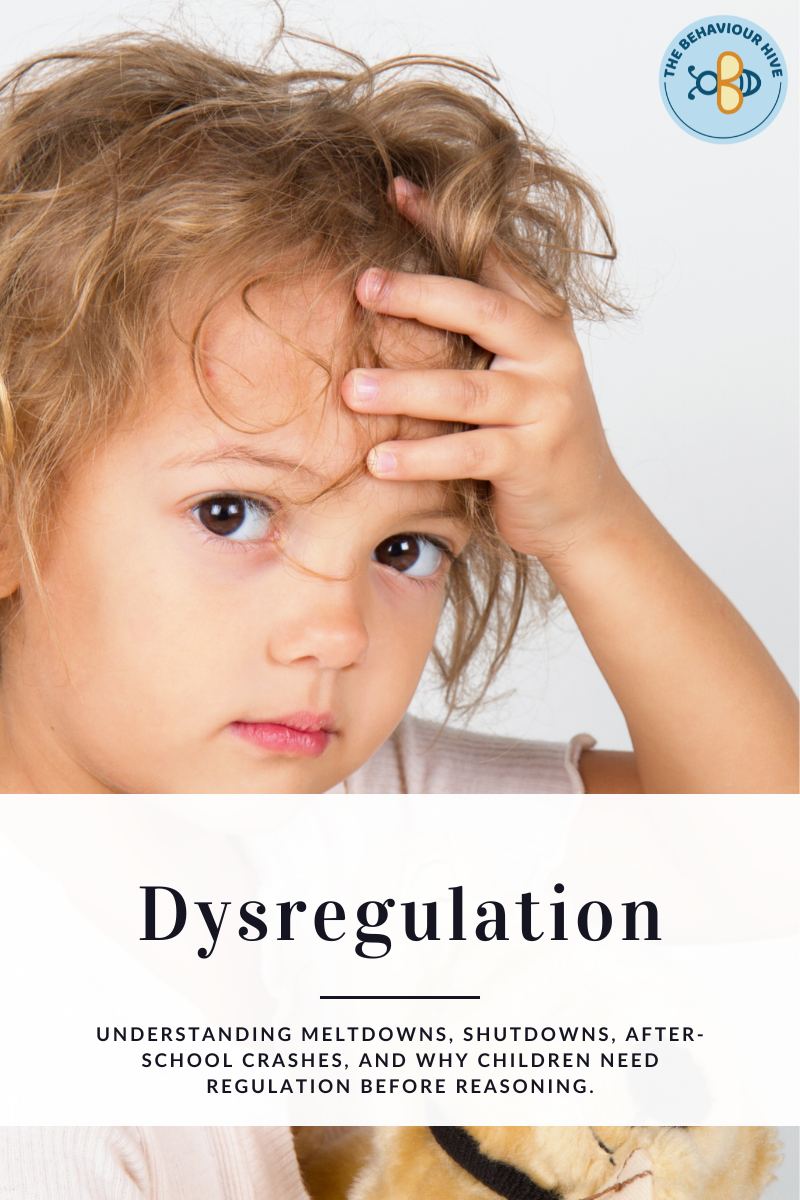
There are moments as a parent when your child's reaction seems so much bigger than the thing that happened.
You gave them the wrong cup.
The iPad battery died.
It was time to leave the playground.
Their sibling walked into the room.
You asked them to put their shoes on.
And suddenly everything has fallen apart.
It can feel completely out of proportion.
But very often, the thing we see immediately before the meltdown is not the whole story.
It may simply be the final thing in a long line of things their brain and body have been trying to manage.
That is where understanding dysregulation can be really helpful.
What do we actually mean by dysregulation?
Dysregulation is what happens when a child's ability to cope becomes overwhelmed.
At that point, they may have much less access to the skills we know they have at other times.
They may struggle to listen to you.
They may not be able to explain what is wrong.
They may find it impossible to wait.
A small disappointment might suddenly feel enormous.
They may scream, cry, hit, run, throw things or drop to the floor.
Or they may do the complete opposite.
They may freeze.
They may go silent.
They may hide.
They may stop responding.
They may seem to completely shut down.
Both can be dysregulation.
And that is important, because we can sometimes make the mistake of assuming that a quiet child is a calm child.
Sometimes they are.
Sometimes they are simply overwhelmed in a quieter way.
The last straw is not always the cause
Imagine your child's ability to cope as a cup.
Throughout the day, little things keep being added.
Maybe they did not sleep particularly well.
Their socks did not feel right.
Breakfast was rushed.
The journey to school was noisy.
Someone was absent from class and the routine changed.
The classroom was busy.
They were expected to sit, listen, transition, share, wait, communicate and manage other people all day.
Maybe they were trying very hard not to show how overwhelmed they felt.
Then they come home and you say, “Can you put your shoes away?”
And that is when the explosion happens.
It is very easy for us to look at the shoes and think, This is ridiculous. Why are we having a meltdown over putting away a pair of shoes?
But perhaps we are not really seeing a meltdown about shoes.
Perhaps the shoes were simply the final drop in an already full cup.
Lots of different things can contribute
For some children, sensory input plays a huge role.
A supermarket is not just a shop. It can be fluorescent lighting, music, announcements, trolleys rattling, tills beeping, strong smells, queues, people moving unpredictably and strangers brushing past.
A classroom might involve chairs scraping, children talking, bells ringing, visual clutter, unexpected touch and lots of spoken information.
Even something as simple as getting dressed can involve labels, seams, socks, tight waistbands, cold clothes and unwanted touch.
Other children become overwhelmed by communication.
They may be trying to understand too much spoken language at once. They may know what they want but cannot explain it. They may be asked multiple questions when they need more processing time.
Transitions can be another huge source of stress. Stopping something enjoyable, starting something difficult, leaving somewhere, waiting or coping with an unexpected change all require flexibility.
And then there are the basic things we sometimes overlook because they seem too obvious: hunger, thirst, tiredness, pain, illness and needing the toilet.
All of these can affect a child's ability to regulate.
Dysregulation can look like defiance
This is where things can become difficult for adults.
A dysregulated child can look very oppositional.
They might shout “NO!”
They might ignore you.
They may refuse something they can normally do.
They may speak sharply.
They may run away.
They might push something across the room.
And if we interpret all of that as deliberate defiance, our natural response may be to increase pressure.
“You know how to do this.”
“I'm not asking you again.”
“Stop being ridiculous.”
“You are not getting away with this.”
But if the child is already overwhelmed, increasing the pressure can sometimes push them further into dysregulation.
That does not mean we abandon boundaries.
It means we try to understand the state the child is in before deciding what they need from us.
Sometimes the most useful question is not, Why won't they do this?
It is, What is making this difficult for them right now?
Meltdowns are not the same as tantrums
People often use the words meltdown and tantrum interchangeably, but I think it is useful to distinguish between them.
A child may have a tantrum because they want something or are trying to change an outcome.
A meltdown is generally rooted much more strongly in overwhelm and loss of regulation.
During a meltdown, the child may no longer be able to reason, negotiate, problem-solve or simply stop.
They are not necessarily thinking, If I keep screaming, Mum will give me what I want.
They may simply be completely overwhelmed.
The Open University has a useful discussion of autistic meltdowns and shutdowns and describes both as responses that can emerge when someone becomes overwhelmed by sensory or emotional input, unexpected changes or the cumulative effort of masking and coping.
The distinction matters because our response should match what is happening.
If a child is overwhelmed, our first job is to help them become safe and regulated again.
The teaching can come later.
Shutdowns deserve attention too
We tend to notice the child who screams.
We may not notice the child who disappears inside themselves.
Shutdowns can look like going silent, hiding, freezing, staring, withdrawing from interaction or simply being unable to respond.
Because there is less disruption for the adults around them, these children can sometimes be missed.
But quiet distress is still distress.
If your child appears to shut down when overwhelmed, repeatedly asking, “What's wrong? Talk to me. Tell me what's wrong,” may actually add more pressure when language is already difficult.
Sometimes the support is simply being nearby, reducing what is being asked of them and allowing time for their system to recover.
“They know better” is not always helpful
This is something I hear frequently:
“But they know they're not supposed to hit.”
“They know how to ask for a break.”
“They know the rule.”
And the parent or teacher may be completely right.
The child does know.
But knowing a skill and being able to use that skill while overwhelmed are not always the same thing.
Think about adults.
We all know we should stay calm during an argument.
We know we should take a breath before responding.
We know shouting rarely improves things.
And yet, when we are very stressed, tired or emotional, we do not always access the skills we know perfectly well.
Children are no different.
A child might be able to tell you after the event exactly what they should have done.
“Next time I'll ask for a break.”
Fantastic.
But the next time they become overwhelmed, they may still need help accessing that skill.
Rather than saying, You know better, it can be more useful to ask, What stopped them being able to use that skill in the moment?
What do we do when dysregulation is already happening?
When a child is dysregulated, less is often more.
Fewer words.
A calmer voice.
Less arguing.
Less pressure.
More space.
More predictability.
Safety first.
This is not usually the time for a long explanation about why their behaviour was unacceptable.
It is not the time for, “Why are you doing this?”
And it is definitely not the time for a lecture about what will happen next time.
A dysregulated brain is not in the best place for learning.
Sometimes useful language sounds incredibly simple:
“I'm here.”
“You're safe.”
“We'll wait.”
“This is hard.”
“I won't talk too much.”
“When your body is safe, I can help.”
Then once the child is calm, we can return to teaching.
Co-regulation comes before self-regulation
We often tell children they need to learn how to self-regulate.
And yes, over time we absolutely want children to develop ways of recognising and managing their own emotions and needs.
But children do not usually develop those skills entirely by themselves.
They learn through being regulated with.
That is co-regulation.
You may slow your voice down.
You may sit nearby.
You may help them move somewhere quieter.
You may remind them what is happening next.
You may offer a familiar sensory tool.
You may help them with the first step of something that suddenly feels impossible.
You may simply stay predictable while everything feels chaotic to them.
That does not mean you have to be perfectly calm every time.
You are human too.
There will be moments when you become frustrated, raise your voice or realise afterwards that you added to the situation rather than calming it.
That does not undo everything.
Repair matters.
You can say, “I was frustrated too and I shouted. I'm sorry. Let's try again.”
Children do not need adults who never get anything wrong.
They need adults who can reconnect after hard moments.
Prevention matters too
Some of our best regulation support happens when the child is already calm.
We can look at patterns.
Does dysregulation happen every day after school?
Is leaving preferred places particularly difficult?
Does the supermarket regularly end badly?
Are mornings rushed?
Does your child cope better when they know exactly what is happening next?
Then we can start making practical changes.
Perhaps we build in half an hour of decompression after school before asking questions.
Perhaps we use a visual schedule.
Perhaps we give warnings before transitions.
Perhaps we offer headphones in busy environments.
Perhaps we break a task into three small steps instead of presenting the whole thing at once.
The aim is not to create a life in which your child never experiences frustration.
That would not be realistic or helpful.
The aim is to reduce unnecessary overwhelm and gradually help them build the skills they need to cope with difficult moments.
What happens afterwards matters
Once everyone is calm, we can reflect.
But keep it manageable.
We do not need a 20-minute debrief after every difficult moment.
Sometimes it can be as simple as:
“Leaving the park was really hard today. Next time we'll use the timer.”
Or:
“You wanted a break but you hit me. Hitting isn't safe. Next time I'll help you use your break card.”
Then reconnect and move on.
The goal is learning, not shame.
Hard moments do not need to become a child's identity.
They had a difficult moment.
They became overwhelmed.
We supported them through it.
And tomorrow, we keep teaching.
Looking underneath
I think the biggest shift dysregulation asks us to make is this:
Do not only look at what happened on the outside.
Look underneath.
Was your child exhausted?
Was something too noisy?
Did they understand what was expected?
Did they need more processing time?
Were they frightened of getting it wrong?
Had they already been coping with far too much?
Was there a communication difficulty?
Were they hungry, uncomfortable or in pain?
We will not always know exactly what caused a child to become dysregulated.
And we do not need to get it right every time.
But curiosity gives us somewhere much more useful to begin than judgement.
Because once we understand that dysregulation is often what overwhelm looks like on the outside, the question changes.
Instead of simply asking, How do I stop this behaviour?
We can ask, What does this child need to be able to cope better next time?
That is where meaningful support begins.
Further reading
The Open University's OpenLearn platform has an accessible piece on autistic meltdowns and shutdowns and why these experiences should not automatically be described as tantrums.
There is also a growing body of research looking at emotion regulation and co-regulation in autistic children, including the role of sensory experiences, unpredictability, communication difficulties and caregiver support.
If you are reading around the topic, I would particularly recommend looking for resources that discuss both outward meltdowns and quieter shutdown responses. Both matter, and both can tell us that a child is struggling to cope.
If you are based in Ireland and want to learn more about dysregulation, emotional regulation, sensory overload, meltdowns, and shutdowns, these Irish resources are a good starting point.
The HSE has autism guidance for families that discusses everyday life, behaviour, meltdowns, and support at home. Their advice includes speaking with your GP, primary care team, teacher, or Children’s Disability Network Team when you need additional support.
Middletown Centre for Autism provides training and resources for parents, carers, and professionals across Ireland and Northern Ireland. Their training includes topics such as autism and emotional regulation, and they also have resources on sensory processing differences, which are highly relevant when thinking about dysregulation.
Some Children’s Disability Network Teams also share public parent resources. For example, CHO7 CDNT has an emotional regulation resource page that references parent webinars and practical supports, including calm zones at home and resources from Middletown Centre for Autism.
